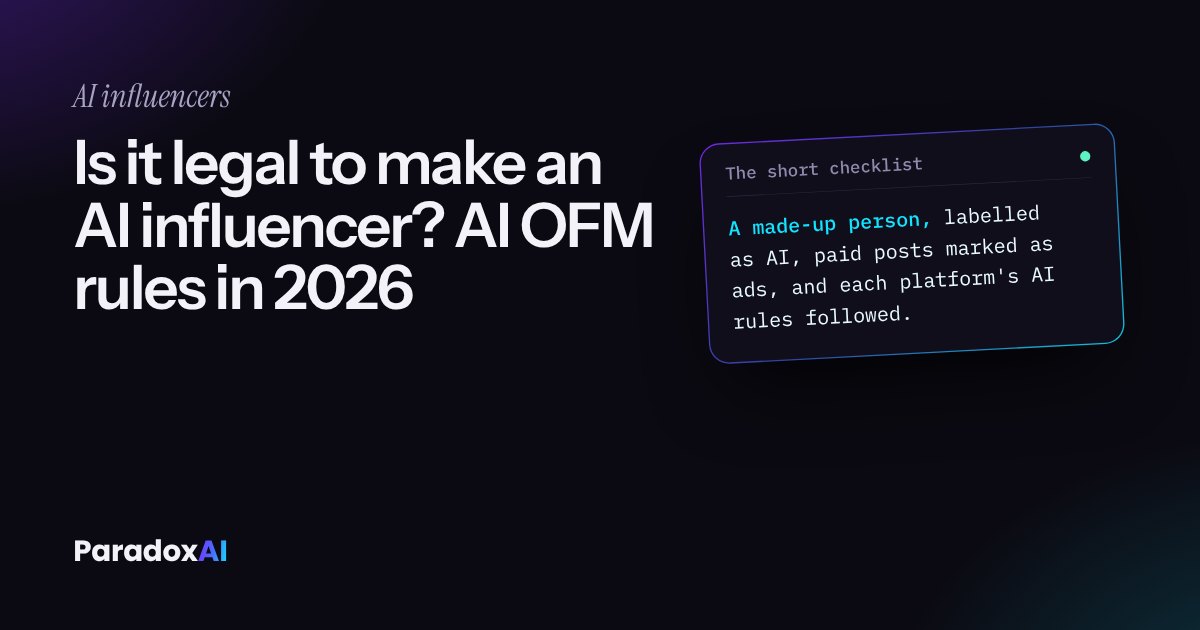
In the EU, the US and the UK, the places this guide covers, yes: you can make and run an AI influencer, as long as she is a made-up person, she is clearly labelled as AI, her paid posts are marked as ads, and you follow each platform's own AI rules. Using a real person's face without their consent can break the law (likeness rights vary by place), sexual images of a real person without consent are a crime in the US and the UK, and sexual content involving minors is illegal. 2026 brought new labelling rules in the EU and on Instagram, below. This is a plain-English overview, not legal advice: check the rules where you live and where your followers are.
The short checklist
- A made-up person only. Never a real person, a celebrity or someone you know.
- Nobody who looks under 18, in any picture, ever.
- Say she is AI: in her bio, and with each platform's own AI label.
- Mark paid posts as ads, and say when a link earns you money.
- No fake reviews. She can show a product, but never pretend to be a real customer.
- Follow each platform's AI policy, and read it again when it changes.
The EU: AI labels since 2 August 2026
- Article 50 of the EU AI Act applies since 2 August 2026. Whoever publishes AI-made images, video or audio that look real must clearly say they were made or changed by AI.
- The Commission's guidelines of 20 July 2026 count a realistic picture of something that could exist, even if it never happened, so a photorealistic AI person may be covered: the guidelines say context and what the audience expects matter.
- If an AI chatbot writes her messages, people must be told they are talking to an AI, at the latest at the first message.
- The AI tools themselves must mark what they make in a machine-readable way; tools already on sale before 2 August 2026 have until 2 December 2026.
- Breaking these rules can cost up to EUR 15 million or 3% of worldwide yearly turnover.
- From 2 December 2026 the EU bans AI systems that make realistic sexual images of an identifiable person without their consent.
The US: the FTC and New York
- The FTC's endorsement rules (2023) cover virtual influencers: sponsorships and paid links must be disclosed clearly, and a platform's own disclosure tool may not be enough.
- The FTC's rule against fake reviews (in force since 21 October 2024) bans reviews that pretend to be by someone who does not exist. The rule doesn't ban AI avatars as such, but what they say cannot be a fake testimonial.
- New York's synthetic performer law (in force since 9 June 2026): an ad that shows an AI-made person must say so clearly. Fines are $1,000 for a first breach and $5,000 after that.
The platforms
- Instagram: since 31 August 2026 profiles that show an AI-made person should switch on the AI-generated profile label in their profile settings. Unlabelled ones may be left out of recommendations. Meta also asks for its AI label on realistic AI video and audio.
- TikTok requires a label on realistic AI-generated content, and reads the hidden AI marks some tools add.
- YouTube asks creators to disclose realistic altered or AI-made content. Repeated failure can mean a label added for you, removed videos or losing the Partner Program.
- Fanvue accepts AI creators: the AI must be clearly disclosed, the bio must say she is AI, and the real person who owns the account passes ID and liveness checks (from a summary of Fanvue's terms dated 1 October 2026; read Fanvue's own policy). How to make an AI model for Fanvue has the details.
- OnlyFans requires AI content to be labelled (with #ai, for example) and to show the verified creator. In August 2026 it was reported that fully AI accounts are not allowed there.
A real person's face
- Never use a real person's face or likeness without consent. In the US, likeness rights depend on the state; Tennessee's ELVIS Act, for example, protects voices and faces from AI copies.
- The US TAKE IT DOWN Act (signed 19 May 2025) makes it a crime to publish intimate images of a real person without consent, AI fakes included, and platforms must remove reported images within 48 hours.
- In the UK, since 6 February 2026, creating an intimate image of an adult without consent, or asking someone to, is a crime, fakes included.
Who owns her pictures
The US Copyright Office said in January 2025 that a prompt alone does not make you the author of an AI image. Your own creative choices and edits to it can be protected. Her look and her story are yours to build; just don't expect copyright in every raw picture.
So is AI OFM legal?
None of the rules above bans an AI model account as such. What matters is that the platform allows AI creators and you follow its rules: she is made up, labelled as AI, and you verify who you are. Fanvue accepts AI creators; OnlyFans was reported in August 2026 to have banned fully AI accounts. AI OFM, the honest way covers the rest. Our own terms don't allow using ParadoxAI's tools to make nudity, sexual content or pictures of real people.
Sources
- EU AI Act transparency duties in force (Goodwin, 3 August 2026)
- Article 50 and the Digital Omnibus (Mayer Brown, 30 July 2026)
- The new EU ban on non-consensual sexual deepfakes (Cooley, 3 August 2026)
- FTC endorsement guides cover virtual influencers (FTC, 29 June 2023)
- FTC rule on fake reviews, questions and answers (FTC)
- New York's synthetic performer law (Cooley, 29 January 2026)
- Instagram's AI-generated profile label (Instagram, 31 August 2026)
- TikTok's AI-generated content labels (TikTok, 24 November 2025)
- YouTube's altered or synthetic content disclosure (YouTube Help)
- Fanvue's rules for AI creators, summarised (SirenCY, 1 October 2026)
- OnlyFans and fully AI accounts (Tubefilter, 14 August 2026)
- The TAKE IT DOWN Act (Congressional Research Service, 20 May 2025)
- UK offence of creating intimate images without consent (legislation.gov.uk)
- Copyright and AI, Part 2 (US Copyright Office, 29 January 2025)